

By Lindenberg Junior | Contribution: Lucas Veiga / Cristiane Alves

São Paulo’s city center is a historic and bustling area filled with cultural landmarks
We have updated our short guide about São Paulo in 2017, but it is still valuable for 2021, and here we bring what is new and trending as well as what is traditional and worth checking. The biggest city in South America and considered the most important political and cultural center in Latin America, São Paulo is the heart of Brazil. It is the Brazilian city with the largest companies (national and multinational) and it has a lot to offer: great hotels, giant malls and many options for having fun.
You can go to nice restaurants, find great tourist and leisure activities, and enjoy the nightlife, be it at a fancy restaurant, in a club or in small bars, all of them ready to show why São Paulo is considered the world capital of cuisine. Now we give you this text – a guide that can be really useful in your next trip to “Sampa”.
Fashion
People from the city go to the Outlets when they want to buy affordable clothing. In Vila Mariana you can find one at the Rua Pelotas (near SESC Vila Mariana). Another good one is the Stand Center located at the famous Avenida Paulista. There you will also find import fragrances, cool watches and all kinds of electronic products sold at good prices. Other outlets of interest can be found in Itaim Bibi and downtown.
On José Paulino and 25 de Março streets, and the main streets in the Brás neighborhood are popular places where you can find fashion articles at an excellent price. If you’re interested in large quantities, those places also sell wholesale. These places are visited by Brazilians from every part of the country for a “shopping trip”. You will even find many Paraguayans, Uruguayans and Argentines doing some shopping here. One section has several stores that sell cloth and fabrics. Curiously, most of them are managed by Arabian descendants. Lots of patience and a good disposition are required to face this “challenge”, since these places are visited primarily by resellers.
If you want to buy trendy or posh clothes, go to the stores that sell the leftovers from past seasons or with small defects from the most famous brands for a nice price. The Offashion (Rua Raul Saddi, Butantã) is the place to go for these kinds of finds. For those with a little more money in their pockets who want to buy high fashion wear, Oscar Freire street is still the most traditional place with a “Beverly Hills Style”.
Over there you’ll find, among others, stores by Forum, Zoomp, Osklen, Armani and Gucci. Walk a little more and you’ll find the Oscar Freire and Haddock Lobo streets and the Alameda Lorena. There you’ll find more sophisticated shops from world famous brands. Take the time to visit the decoration stores, and the Empório Santa Maria – the best place in town to buy high quality food, wines, fruits, teas and chocolates.
Arts & Culture
Without a doubt, the MASP (Modern Art Museum of São Paulo) is still one of São Paulo’s greatest tourist destinations. It’s an obligatory stop if you have an interest in arts and culture, as it always has exhibits and cultural shows. The Bienal of Ibirapuera is another place that unfailingly has something worth looking at. Since last January (2010) the Afro-Brazilian Museum has been open, depicting the trajectory of the influence of African culture in Brazil.
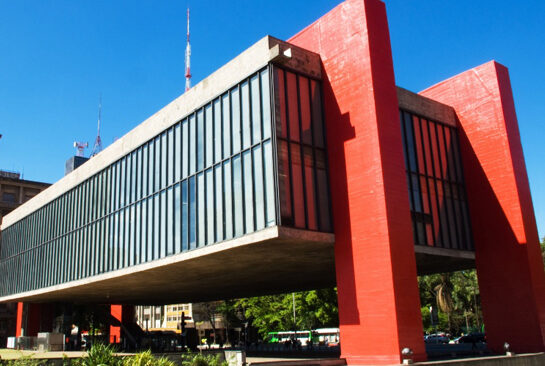
MASP is known for its striking modern architecture and world-class art collection.
On Saturdays the Benedito Calixto Fair in Pinheiros is the place to go if you’re a cool kind of person: sunglasses, pottery and antiques (from old records and record players to jewels, silver pieces and even clothes) can be found there. Close to the fair you’ll find the food court where among the many options you can taste a good Acarajé and witness the “Chorinho” meeting.
Speaking of Chorinho, here are two other places where you can hear good music without spending any money: the “old school choro” players are always found in downtown in the many bars at the poetic address (made famous by Caetano Veloso in his song Sampa), Avenue Ipiranga with Avenue São João or at the Contemporânea store (Rua General Osório close to the Luz subway station). This is where some local legends of the chorinho traditionally meet and play every Saturday.
Another important place is the M.I.S (Museum of Image and Sound), with its huge cultural archives. The SESCs can never be forgotten either; in São Paulo they are cultural and social centers as good as any found in the so-called First World. They consistently present different kinds of cultural workshops, music and dance concerts on a daily basis (except on Mondays).
The Pompéia, Vila Mariana and Pinheiros branches usually offer the most sought-after programs, but it’s always nice to see what’s happening on the other branches as well. Finally, you can also pay a visit to the FNACs (there are two of them: one at Avenida Paulista and another in Pinheiros). Books, movies and records are always a nice option (also check the Sensorial Discos at Rua Augusta, where you can find a lot of prime Brazilian music at sale prices).
The Casa das Rodas is one of the last standing big houses that used to be such a part of historic Avenida Paulista. Today you can see exhibitions by famous artists if you go there. This is a must-see if you’re interested in arts and architecture.
On Sundays Avenida Paulista is closed to car traffic, which opens space for several artists to perform on the streets with shows ranging from MPB to rock covers. The proposal was to create a new space for the residents of the city, so the street on this day is released for pedestrians to use as they wish.
Capoeira
In São Paulo you’ll find some of the most respected Capoeira masters in the world. People like Mestre Suassuna, the legendary master from the Cordão de Ouro group, and Mestre Tucano Preto from the biggest capoeira group on the planet. Another attraction is the open “roda” (showing) that happens every Sunday at Praça da República, downtown.

The historic Luz Station in São Paulo
It’s one of the most traditional Capoeira meetings in town and a large number of people show up ranging from tourists and curious visitors to professional capoeiristas. These events don’t require the use of specific capoeira clothing (the abadá) or the “cordão” (belt-like ranking system), even with the presence of famous names like Mestranda Leopoldina and Mestre Ananias.
There’s a lot of excitement as the game becomes a “Russian roulette” since no one knows how good or strong the opponent will be. Right near there in the Galeria 24 de Maio there are two good stores – Luar Capoeira and Sobrado – with capoeira articles. For percussion enthusiasts, a great place is “Batucadas 1000” located at Rua Teodoro Sampaio, 836, Pinheiros.
Cuisine
In São Paulo you can order your pizza by the meter and the pizza is square! If this left you curious, go to Bar Graminha (Rua Aspicuelta, Vila Madalena). And what about a bar where you can take a ride in a charrete (a horse-drawn carriage)? This is at Bar Piratininga, also in Vila Madalena.
By the way, it’s in this neighborhood that you’ll find the most open-minded/alternative bars in town, where artists, poets, journalists and philosophers are found. Bexiga is famous for Italian restaurants such as Famiglia Mancini. There’s also the very traditional Capuano at Conselheiro Carrão. This street has many other wonderful restaurants with various types of meat, including barbecue. Also worth noting is Candaluga (José Maria Lisboa, Jardim Paulista) with its high-quality ambience, food and service (it’s a Brazilian version of a bona fide Lombardian restaurant).

Liberdade is one of the most vibrant neighborhoods in São Paulo, known for its strong Japanese influence
The Asian kitchen has a strong presence in the Liberdade district. Every Sunday there is an Asian culture fair where you can buy pottery and check out music and art exhibitions. It’s easy to spot restaurants and small bars serving kibes, esfihas and other Lebanese specialties. Almanara, with almost 60 years, is the most famous Lebanese restaurant in town.
The Mercado Municipal, completely revitalized a few years ago, is an obligatory stop on your trip, with every kind of food you can think of (exotic fruits, spices, sweets and much more). Bar Sujinho (Rua da Consolação, close to Avenida Paulista) is another traditional address that stays open until late (4am).
If Brazilian food is the subject, it’s impossible not to mention the many churrascarias (Brazilian-style barbecue restaurants), among them “Fogo de Chão” with three different locations (Santo Amaro, Moema and Brooklin – plus a Los Angeles address!) and Boizão Grill (Rua Pedro Vaz de Campos, 33, Pari). Restaurants with typical Bahian food are also a must, especially Barra Baiana (Rua Traipu, 156, Perdizes) and Iemanjá (Avenida Pavão, Moema). For caipira/country-style food try Graça Mineira (Rua Machado Bitencourt, 75, Vila Madalena) and Caipira (Rua Amazonas da Silva, 21, Vila Guilherme).
The “Galeria dos Pães” (Bread Gallery) at Rua Estados Unidos, Jardins, is also worth visiting. There’s a huge variety of wines, cheeses and breads. On the upper floor there’s a self-service restaurant where you can buy food by weight. It’s open 24 hours and offers live music. Another highlight is Chakras Espaço Gastronômico e Cultural (Rua Dr. Melo Alves, 294, Jardins), with exhibitions, movies, a dance floor and contemporary food.
Bars & Places to Dance
At the bar of the Cambridge Hotel (downtown, at the beginning of Avenida 9 de Julho) there’s always a party with many foreigners and modern people. Afrospot (13 de Maio 48, Bela Vista) offers alternative nightlife with tribal designs and DJs mixing live visuals.
Love Club & Lounge (Rua Periquita, 189, Vila Olímpia) usually hosts international DJs playing techno and hard techno. Vila Olímpia is the neighborhood for the rich and executives, while Vila Madalena is known for alternative music and affordable restaurants. Downtown offers rock, hip-hop and old-school parties, especially around Rua Augusta.

The Municipal Market of São Paulo is famous for its diverse selection of exotic fruits, spices and traditional Brazilian flavors
Even on Mondays or Tuesdays you can find high-class parties. Urbano (Cardeal Arcoverde Ave.) offers black music and acid jazz. Concerts at lower prices can be found via SESC (www.sescsp.com.br). Bourbon Street offers New Orleans-inspired blues and jazz shows.
Among famous concert halls: Via Funchal (Vila Olímpia), Credicard Hall (Marginal Pinheiros, Santo Amaro), Citibank Hall (Moema) and Tom Brasil (Av. das Nações Unidas, Chácara Santo Antônio). Major artists often perform in these venues.
Other Interesting Places Worth Checking Out
Japan House – A museum on Avenida Paulista dedicated to Japanese art, with gastronomy, art and technology.
Galeria Ouro Fino – A youth hub with rock stores, alternative fashion, tattoos and underground parties.
Galeria 24 de Maio – A “New York-style” space with record stores, streetwear and rare vinyl.
Cinema Espaço Unibanco – Independent cinema near Rua Augusta.
Praça Pôr do Sol – Famous sunset viewpoint in Alto dos Pinheiros.
Zoo, Botanical Garden & Simba Safari – The São Paulo Zoo is the largest in Latin America, located near Avenida Cursino.
Interlagos Autodrome – Essential for Formula 1 and motorsport fans.
Serra da Cantareira – Great for hiking and nature trails near Horto Florestal.
Museu do Ipiranga – Important historical museum about Brazil’s independence.
Rua 25 de Março – Popular commercial street with cheap goods and huge crowds.
Rua Santa Ifigênia – Electronics shopping hub.
Rua do Arouche – Known for leather goods.
Rua da Consolação – Major lighting and lamps market.
Rua Teodoro Sampaio – Musical instruments and furniture.
Rua Bem-Te-Vi – Outlet-style fashion street in Moema.
Motels of São Paulo – Luxury and affordable hourly stays; commonly used for private romantic encounters in Brazil.
Churches – Highlights include Mosteiro de São Bento, Catedral da Sé and an Orthodox church near Paraíso station.
Final Note

The commerce on Rua 25 de Março is one of the most well-known in Brazil.
São Paulo is a city of great opportunities, perfect for business, shopping and entertainment. Even without beaches and the tropical lifestyle of other Brazilian cities, it is a cosmopolitan metropolis where everyone can find something to do and enjoy.
São Paulo has the largest Japanese and Lebanese communities outside their countries, and 65% of the population has an Italian surname. For visitors and paulistanos (residents of São Paulo), this is a city like no other.
*Special thanks to capoeirista Cristiane Alves and journalism student Lucas Veiga for the great research and contribution.
** For airline tickets from the U.S to Brazil or Latin America, customized travel packages, hotels and cruises, please visit our travel agent page or contact Magali Da Silva by phone or whatsapp: 1 (323) 428-1963.
FAQ – Frequently Asked Questions
1. What is São Paulo best known for?
São Paulo is best known for its cultural diversity, strong business economy, world-class restaurants, and vibrant nightlife.
2. Is São Paulo worth visiting for tourists?
Yes. São Paulo offers museums, gastronomy, nightlife, shopping streets, and cultural experiences unmatched in Brazil.
3. What are the must-visit places in São Paulo?
Top places include Avenida Paulista, MASP museum, Liberdade district, Municipal Market, and Vila Madalena.
4. Is São Paulo expensive for travelers?
It can be both affordable and luxury-oriented. The city offers options for all budgets, from street markets to high-end dining.
5. What is the best time to visit São Paulo?
São Paulo can be visited year-round, but spring and autumn offer the most pleasant weather for exploring the city.






There are a lot of things to do in Sao Paulo. It is one of the most cool Brazilian capitals to visit! For those who are visiting SP and want to know more about Brazil’s nature, a good tip is to travel to Foz do Iguaçu. There are several buses that take this route, you can check on this site and buy your tickets https://brazilbustravel.com/sao-paulo-tiete-sp-x-foz-do-iguacu-pr. Take a look at it 😉