Capoeira is more than a martial art — it is freedom, resistance, music, and survival. Women have fought for space within this Afro-Brazilian tradition, overcoming prejudice to become leaders, teachers, and masters. Today, women in capoeira continue to redefine strength, femininity, and power in the roda.
By Monique Mizrahi

Women in capoeira prove that strength and femininity are not opposites — they are power together.
Capoeira is freedom, expression, creation, improvisation. It’s a song, a dance, a martial art, a philosophy for survival. It embodies respect, dignity, and grace as a conversation, a ritual, a tradition, and a savior.
“Zum zum zum, capoeira salva um” (Zum zum zum, capoeira saves).
Women from all walks of life have long been fighting for their rights. Whether it’s the right to vote or the right to choose, women are demanding that their voices be heard. In ancient societies, women were healers and doctors, experts in natural remedies and childbirth. There were women warriors and military leaders who held respected roles, blending masculine strength and feminine charm.
However, with the scientific revolution and the industrialization of religion, women were increasingly viewed as inferior, confined to domestic spaces. Over the past forty years, women have worked to erase the “shadow of a man” stereotype and claim independence in what they do, who they are, and what they can become.
Capoeiristas.
The History: Capoeira Is Born

Capoeira was born as a strategy of survival among enslaved Africans in Brazil.
From 1538 to 1888, millions of Africans were forcibly taken to Brazil by the Portuguese. Families were torn apart. People were bought, baptized, branded, whipped, and sold. Tribal identities, languages, and cultures were deliberately fragmented.
Living and working conditions were inhumane. Enslaved men labored outdoors. Enslaved women endured domestic servitude and sexual exploitation.
In the senzalas (slave quarters), enslaved Africans united through their shared struggle for freedom. Though they spoke different languages, they trained physically — disguising their combat practice as dance when overseers approached.
In the early 1600s, escaped slaves formed quilombos, fortified communities built on resistance and autonomy. There, capoeira emerged as an improvisational martial art played inside a circle — the roda — accompanied by music and song.
Every member of the quilombo trained — women and men alike. Strength was not optional. As Mestre Boa Gente affirms, it was “a necessity for survival.”
Slavery was abolished in 1888, and capoeira was soon outlawed. Formerly enslaved people moved to cities, faced unemployment, and formed survival gangs. Capoeira became associated with street violence, and many practitioners were imprisoned. During this period, women largely withdrew from capoeira due to social pressure and gender expectations.
Society discouraged women from practicing. As Contra-Mestre Jô explains:
“Society greatly discriminated against women who wished to fight capoeira, pressuring them not to participate and labeling them negatively if they did.”

The capoeirist Maquisha
Mestre Bimba and the Rebirth of Capoeira
In the 1930s, Mestre Bimba successfully convinced Brazil’s government to recognize capoeira as national heritage. He opened the first formal academy in Salvador, Bahia, reintroducing capoeira in a structured environment — including for women.
He implemented strict discipline:
-
No smoking
-
Daily fundamentals practice
-
Silence during training
-
A relaxed body
Women returned to the roda.
The Present: Women in the Roda
For decades, Brazilian society claimed capoeira was “for men.” Jô remembers being the only woman in her class. Her mother feared it was too violent. But she persisted.
Today, capoeira academies around the world welcome women of all ages. Mestra Suelly, the first female mestre in America, affirms:
“There is hope for everyone in capoeira, for any body type. Everyone must find their own game.”
While student participation may approach 50/50 in many academies, women remain underrepresented at higher ranks.
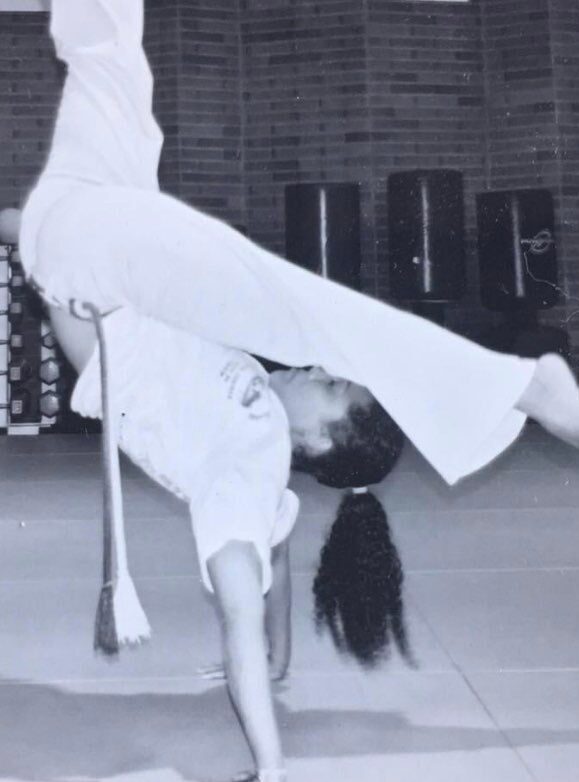
Instrutor Guerreira
Professora Marrom states:
“It’s more rare for a woman to receive a higher rank. Women are always fighting for their rights.”
And yet:
“Women bleed for capoeira — heart, soul, sweat, energy — and are hardly recognized.”
The Future: Sweat, Play, Respect, Unite
Are men inherently better at capoeira?
All interviewed women answered: No.
While men may possess greater upper body strength on average, capoeira is about character, malicia (strategic trickery), agility, and dialogue within the roda.
Challenges persist:
-
Work overload
-
Illness
-
Motherhood
-
Social expectations
Yet many women continue training through pregnancy and beyond.
Another obstacle? Competition between women.

Mestra Suelly between Contra-Mestre Versátil (left) and Mestre Acordeon (right) years ago.
Marrom notes:
“When women get emotional in the roda, they don’t perform. It becomes: I can’t lose.”
Unity, not rivalry, is essential.
Music also remains central. The ladainha honors past mestres. The berimbau leads. The pandeiro and atabaque join. Songs narrate history and comment on the game.
“Capoeira music tells stories and remembers people, times, and places. It’s essential,” says Marrom.
Women have much to contribute musically — and that space continues to grow.
A Message to Women in Capoeira

The capoeirist and DJ Renata Potira
Marrom leaves this wisdom:
“Women must not forget to be women. Play as a woman and remember to be feminine because that’s what makes women in capoeira really beautiful. We are strong AND feminine.”
Iê viva a mulher na capoeira, camará!
Long live women in capoeira.
*Monique Mizrahi is a capoeirista known as Risadinha. She warmly thanks Morango, Geneviève, Boa Gente, Girafa, Trança, Concha do Mar, Capoeira Batuque and especially Suelly, Jô, Marrom, and Guerreira for their generous participation in this article. Muito dende e axé – Obrigada!
FAQ – Frequently Asked Questions

Professora Grace “Marrom” between capoeiristas and dancers Emmy “Brasileira” and Melanie “Sininho”.
1. What is capoeira?
Capoeira is an Afro-Brazilian martial art that blends fight, dance, music, and acrobatics, developed by enslaved Africans in Brazil.
2. Did women participate in capoeira historically?
Yes. In quilombo communities, both men and women trained for survival. However, social pressures later limited women’s participation.
3. Who was Mestre Bimba?
Mestre Bimba legalized and formalized capoeira in the 1930s, opening the first academy and allowing women to return to training.
4. Are there female capoeira masters?
Yes. Women such as Mestra Suelly have achieved the rank of mestre, though they remain underrepresented at higher levels.
5. What challenges do women face in capoeira today?
Challenges include gender bias, under-recognition at higher ranks, balancing motherhood and training, and competition dynamics within the roda.