The berimbau is a traditional Brazilian single-string percussion instrument closely associated with capoeira. Made with a wooden bow, steel string and gourd resonator, its rhythm guides movement inside the roda and connects capoeira’s music, dance and Afro-Brazilian cultural traditions.

The berimbau is the iconic single-string instrument that gives capoeira its distinctive sound. Photo by Claudia Passos
To the haunting sound of the berimbau, novice capoeiristas from Los Angeles, San Francisco, San Diego, Santa Barbara, New York, Paris, Tel Aviv, Tokyo, Sydney and other cities follow their teachers, swaying from side to side. It is the ginga that has enchanted the world as capoeira, a Brazilian art form, has become a popular dance, fitness and cultural practice in many cities across the U.S., Europe, Asia, Oceania and Latin America.
The sound of the berimbau is one of the most recognizable elements of capoeira. For many people discovering the Brazilian tradition outside the country, hearing its distinctive rhythm is also an introduction to a cultural practice that combines movement, music, history and community.
What Is the Berimbau?
The berimbau is a single-string percussion instrument and a musical bow from Brazil, with African origins and related instruments known by different names in Africa. It was eventually incorporated into the practice of capoeira, an Afro-Brazilian martial art, and became an instrument that guides the capoeiristas’ movement in the roda.
Usually, the faster the berimbau is played, the faster the capoeirista moves during the game. The berimbau gradually came to replace the drum as the central instrument of the jogo de capoeira — the capoeira game — and is now widely associated with the practice around the world.
The relationship between music and movement is fundamental to capoeira. The berimbau does not simply provide a musical background; its rhythm helps establish the atmosphere and pace of the roda.
How Is a Berimbau Made?
The berimbau consists of a wooden bow called a verga, traditionally made from biriba wood, which grows in Brazil. The bow is usually about 4 to 5 feet long.
A steel string, known as the arame, is tightly strung and secured from one end of the verga to the other.
A gourd, or cabaça, is dried, opened and hollowed out before being attached to the lower portion of the verga with a loop of strong string. The cabaça functions as a resonator and helps produce the characteristic sound of the instrument.
This relatively simple construction creates a remarkably versatile instrument. Small changes in how the player holds the bow, string and gourd can produce different tones and sounds.
How Do You Play the Berimbau?
Playing the berimbau requires coordination between both hands.
One hand holds the instrument, with the two middle fingers wrapped around the verga and the little finger positioned underneath the cabaça’s string loop, known as the anel. A small stone or coin, called a pedra or dobrão, is held between the index finger and thumb of the same hand.
The cabaça rests against the abdomen.
In the other hand, the player holds a stick called the baqueta and a small shaker called the caxixi. The arame is struck with the baqueta to produce the sound, while the caxixi accompanies the rhythm.
The dobrão is moved back and forth against the arame to change the pitch produced by the berimbau. The sound can also be modified by moving the cabaça back and forth against the abdomen, creating a distinctive wah-like effect.
These movements may look simple to an observer, but producing the different sounds of the berimbau requires practice, rhythm and coordination.
Berimbau and the Roda de Capoeira

Playing the berimbau requires coordination between the baqueta, caxixi, dobrão and cabaça.
Inside the roda de capoeira, the berimbau becomes much more than a musical instrument.
The roda brings together players, musicians and spectators in a circle where two capoeiristas interact through movement, rhythm and strategy. The music helps establish the energy of the game, while singing, clapping and other instruments contribute to the atmosphere.
The berimbau is traditionally accompanied by instruments such as the atabaque and pandeiro, depending on the group and tradition.
For people learning capoeira in the United States and other countries, understanding the berimbau can therefore provide an important connection to the cultural and musical roots of the practice.
Capoeira and Its Afro-Brazilian Roots
Capoeira developed in Brazil within communities of African descent and became an important form of cultural expression, resistance and identity. Over time, it incorporated fighting techniques, dance-like movements, music, singing and ritual.
The ginga, the characteristic side-to-side movement of capoeira, is at the center of this dialogue between movement and music.
As capoeira spread internationally, the berimbau traveled with it. Today, people can encounter capoeira rodas in cities far from Brazil, including major metropolitan areas in the United States and Europe.
The international expansion of capoeira has also created new generations of practitioners who learn not only the physical movements but also Brazilian musical instruments, songs and traditions.
How Much Does a Berimbau Cost in the U.S.?
The average price of a berimbau in the United States was around $60, according to the original article’s 2017 price reference. At the time, prices could range from approximately $30 to $120.
However, the article cautioned buyers to pay attention to the type and quality of wood used to make the instrument.
You could end up getting inexpensive wood such as araçá, which may break more easily and may not produce the desired sound. The original recommendation was to try to buy a berimbau in person rather than purchasing one online, or at least make sure that the instrument is made from biriba wood.
Note: Because these prices are based on 2017 information, they should be treated as historical price references rather than current U.S. retail prices.
Why the Berimbau Matters to Capoeira
The berimbau is one of the strongest symbols associated with capoeira because it brings together music, movement and cultural tradition.
For capoeiristas, learning the instrument can be part of learning the art itself. Its rhythms, sounds and role in the roda help connect the physical practice to the musical and cultural dimensions of capoeira.
That connection is particularly relevant outside Brazil, where capoeira has become an international cultural practice. From California to New York and from Europe to Asia, the sound of the berimbau continues to introduce new audiences to one of Brazil’s most distinctive cultural traditions.
FAQ — Berimbau e Capoeira
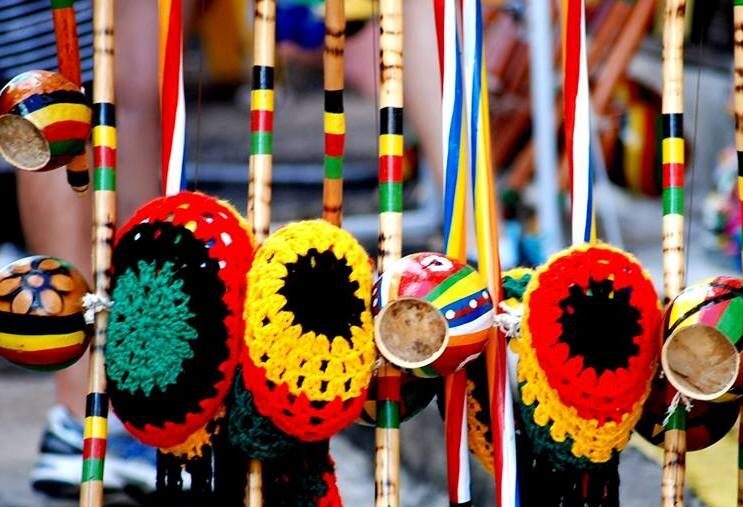
The berimbau connects capoeira’s music, movement and Afro-Brazilian cultural heritage. Photo: Claudia Passos
1. What is a berimbau?
The berimbau is a Brazilian single-string percussion instrument shaped like a musical bow. It consists primarily of a wooden bow, steel string and a gourd resonator and is strongly associated with capoeira.
2. What is the role of the berimbau in capoeira?
The berimbau helps establish the rhythm, pace and energy of the capoeira game. Its sound guides the movement of players inside the roda and is an essential part of capoeira’s musical tradition.
3. What is a berimbau made of?
A traditional berimbau consists of a wooden bow called a verga, a steel string called an arame and a hollow gourd called a cabaça. The player also uses a baqueta, caxixi and dobrão to produce and modify its sounds.
4. How much does a berimbau cost in the United States?
The original Soul Brasil article reported prices of approximately $30 to $120, with an average around $60, based on 2017 prices. These figures are historical and should not be considered current U.S. retail prices.
5. Can I learn to play the berimbau without practicing capoeira?
Yes. The berimbau can be studied as a musical instrument independently, although learning its role within capoeira can provide important cultural and practical context because the instrument is closely connected to the roda, its rhythms and traditions.