Education in the United States is essential but often financially challenging for many students. This article explains why higher education is a priority and how financial aid, scholarships, and grants can make it accessible. It highlights key resources that help students navigate the complex funding system. With the right information, investing in education becomes both realistic and achievable.
By Lindenberg Junior

High tuition costs remain the main barrier to higher education, but financial aid can turn ambition into opportunity.
Education should be accessible to everyone. Yet, for many families in the United States, pursuing higher education remains a challenge — not because of a lack of ambition or talent, but because of cost.
College, university, and even technical or professional specialization programs in the U.S. are expensive. Tuition fees, housing, books, and living expenses quickly add up. For this reason, financial aid has become not just helpful, but essential for millions of students.
The good news? For those who understand how the system works, financing education is possible — and often more achievable than it initially seems.
Education as a Tool for Quality of Life
In today’s society, a solid educational background is widely recognized as one of the most powerful tools for achieving stability, professional growth, and long-term quality of life. A degree or certification can open doors to better-paying jobs, career mobility, and personal fulfillment.
However, for many students — especially immigrants, first-generation college students, and individuals from low-income households — higher education may feel out of reach due to exorbitant tuition costs.
This is precisely why financial aid programs exist.
Financial Aid: How It Works in the United States
Many American institutions, as well as the federal government, offer financial assistance programs designed to support students who qualify based on need or merit.
These programs may include:
-
Federal grants
-
Subsidized and unsubsidized student loans
-
Institutional aid
-
Merit-based scholarships
In many cases, repayment of loans only begins after graduation, once the student is employed. Grants and scholarships, on the other hand, often do not require repayment.
Scholarships: More Than Free Money
Scholarships are another critical pathway to higher education. They are offered by universities, private organizations, foundations, and even corporations.
Some scholarships:
-
Are based on academic performance
-
Reward leadership, sports, or artistic talent
-
Support specific communities or fields of study
Certain programs may require recipients to work for a sponsoring organization for a set period after graduation. While some see this as a limitation, many students view it as an advantage — a guaranteed job after completing their studies.
Why Financial Barriers Still Exist
Despite the availability of aid, many students struggle to pursue higher education due to factors such as:
-
Cultural expectations to enter the workforce early
-
The need to financially support family members
-
Lack of guidance or information
-
Discouragement from elders or peers
-
Limited financial literacy
Among all these obstacles, finances are often the most solvable, provided students have access to accurate information and guidance.
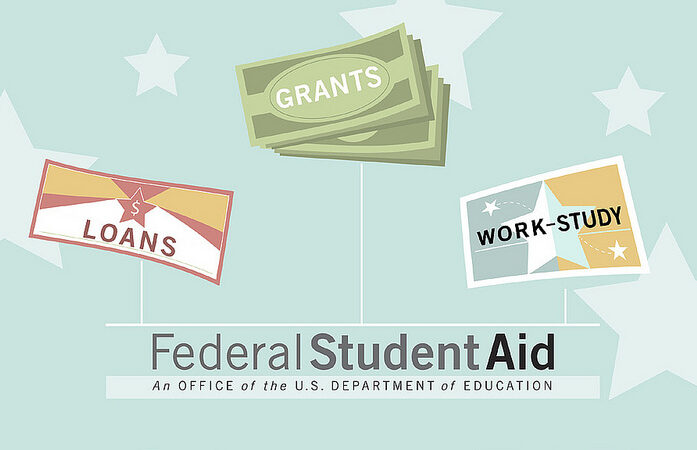
Reliable online resources can simplify the complex process of funding higher education in the United States.
Essential Websites to Finance Your Education in the U.S.
Below are some of the most reliable and widely used resources for students seeking financial aid:
The official website of the U.S. Department of Education, this is the best place to start. It provides comprehensive information on:
-
FAFSA
-
Federal grants
-
Student loans
-
Eligibility requirements
One of the most recognized platforms for college-bound students. Fastweb allows users to:
-
Create a personalized profile
-
Match with scholarships
-
Simplify the financial aid search process
Focused on merit-based scholarships, this site offers valuable information on:
-
Academic awards
-
Athletic and leadership scholarships
-
Tuition discounts from universities
An excellent educational resource that breaks down the complex financial aid system in a clear and accessible way.
A Personal Perspective
For Portuguese-speaking readers, we strongly recommend an article written by editor Lindenberg Junior, who shares his firsthand experience navigating the complex U.S. college admissions process with his son, Giovanni da Silva.
Giovanni was admitted to Syracuse University in 2013 with an 80% scholarship, demonstrating that with the right information and preparation, higher education in the U.S. can become a reality.
Final Thoughts
Education in the United States is not merely important — it is a priority. While the costs can be intimidating, financial aid, scholarships, and strategic planning can transform what seems impossible into an achievable goal.
With knowledge, persistence, and the right resources, investing in education is still one of the most powerful decisions a student can make.
FAQ – Education Financing in the U.S.
Is college in the U.S. really that expensive?
Yes. Tuition and living costs can be high, but financial aid significantly reduces the burden for many students.
What is FAFSA and why is it important?
FAFSA (Free Application for Federal Student Aid) determines eligibility for federal grants, loans, and institutional aid.
Do scholarships always require repayment?
No. Most scholarships do not require repayment, though some may involve work or service commitments.
Can immigrants or international students apply for financial aid?Yes, but eligibility varies. Some aid is federal, while other scholarships are institution-based or private.
When do student loans need to be repaid?
Typically after graduation, once the student is employed.