Authentic Cuban Rumba is one of the most powerful cultural expressions of the African Diaspora in the Americas. Rooted in African religious traditions, percussion, dance, and storytelling, Rumba evolved in Cuba into a vibrant artistic form that continues to influence jazz, salsa, and Latin music around the world.
By Willy Rubén Paffen

Authentic Rumba is one of the most powerful cultural expressions of the African Diaspora in the Americas
Like jazz, the blues, and many forms of Brazilian music, popular Cuban music developed through a rich fusion of African traditions and local influences. It oscillates between sacred Yoruba, Congo, and Abakwa chants and secular musical expressions such as guarachas.
The authentic Rumba emerged through a long process of cultural exchange and adaptation, becoming a complex ritual that combines drumming, singing, declamation, and dance. More than entertainment, it represents a living testimony to the resilience and creativity of African-descendant communities in Cuba.
Four major ethnic groups composed the majority of Africans brought to Cuba during the transatlantic slave trade:
- Yoruba (West Nigeria and Togo)
- Carabalí (Southern Nigeria and Cameroon)
- Bantú (Congo and Angola)
- Arará (Benin)
Much like in Salvador, Bahia, in Brazil, the Yoruba tradition became particularly influential, contributing to the development of Santería, Cuba’s most widespread Afro-religious tradition.
Today, Rumba enjoys greater visibility and respect than ever before, occupying a central place in Cuba’s cultural identity.
The Sacred Language of the Batá Drums
At the heart of Afro-Cuban spirituality are the sacred Batá drums, traditionally used in ceremonies dedicated to the Orishas, the divine beings of the Yoruba tradition.
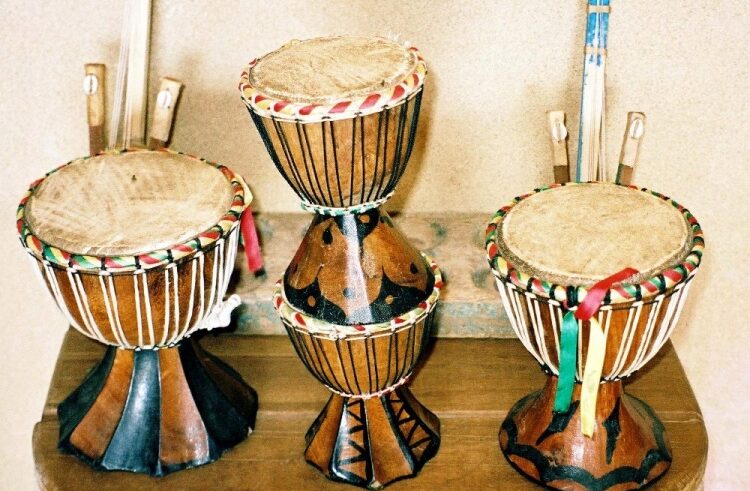
The Batá ensemble consists of three hourglass-shaped drums:
Iyá (Mother Drum)
The largest drum, responsible for leading and improvising.
Itótele (Father Drum)
The medium-sized drum that follows and complements the lead.
Okónkolo (Child Drum)
The smallest drum, maintaining recurring rhythmic patterns.
Traditionally handcrafted from cedar wood and covered with goatskin membranes of different sizes, Batá drums are played by hand while resting horizontally across the musician’s knees.
One of the most fascinating aspects of Batá drumming is its relationship with Lucumí, the ceremonial Yoruba dialect preserved in Cuba. The tonal patterns of the drums mirror the tonal qualities of the language itself.
In Afro-Cuban tradition, the drums do not merely accompany ceremonies—they speak.
Dance as a Sacred Expression
The importance of dance within African-derived religions cannot be overstated.
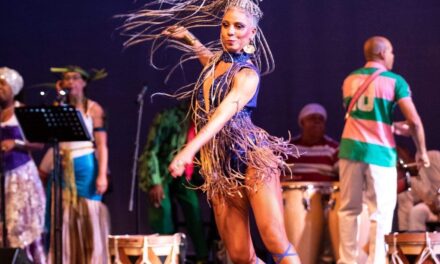
Religious ceremonies brought to the Americas by enslaved Africans almost always combined percussion-based music with precise choreographic movements. Music and dance were never separate elements; they functioned together as a unified spiritual language.
As Afro-descendant communities transitioned from rural plantations to urban neighborhoods, secular dance traditions also developed, reflecting everyday life, resistance, and cultural adaptation.
Afro-Cuban Dances Beyond Rumba
Several Cuban dance traditions preserve strong African influences.
Among the most notable are:
Yuka
An erotic dance of Congolese origin that mimics the courtship behavior of a rooster and a hen.
Quimbumbía
A Congolese dance-game involving the use of two small sticks.
Maní
A boxing-style dance from Angola closely related to Brazilian Capoeira.
Palo
A dance inspired by agricultural labor and rural life.
Tumbandera
A peasant dance performed with one foot buried in the ground while connected by a rope to both a drum and a tree.
Caringa
Dance and percussion function together as a unified spiritual language
A line dance characterized by rhythmic body slaps signaling musical changes.
Rumba
The most internationally recognized Afro-Cuban dance tradition, originating in Cuba’s port communities.
The Evolution of Rumba
Rumba evolved from improvised gatherings using everyday percussion instruments into a sophisticated musical tradition.
Its defining elements include:
- Call-and-response singing
- Improvised lyrics
- Storytelling based on daily life
- Complex percussion patterns
- Distinct dance styles
Over time, specific instruments became central to Rumba performance:
- Quinto
- Tres-Golpes
- Salidor
- Palitos
- Caja
- Shekeré
These instruments helped shape the sound that would later influence Latin jazz, salsa, and numerous contemporary genres.
The Three Traditional Styles of Rumba
While several historical forms have disappeared or become rare, three traditional styles continue to thrive today.
Yambú
Often described as the “dance of the elders,” Yambú features slower, graceful movements.
Women frequently imitate domestic activities, while men perform playful feats such as picking up objects from the floor using only their mouths.
Columbia
Columbia emerged from the secret male societies associated with the Carabalí tradition during the nineteenth century.
Typically performed by a solo male dancer, Columbia showcases:
- Acrobatics
- Knife and sword displays
- Athletic improvisation
- Rhythmic dialogue with the quinto drum
Guaguancó
The most internationally famous form of Rumba, Guaguancó serves as one of the foundations of modern salsa and Latin jazz.
Its signature element is the vacunado, a symbolic and highly theatrical dance interaction between a man and a woman.
The man pursues, surrounds, and attempts a symbolic “injection” through stylized pelvic movements, while the woman responds through playful evasion, seduction, resistance, and control.
The result is a dramatic dance of attraction, tension, and mutual performance.
Muñequitos de Matanzas: Keeping the Tradition Alive
One of the finest examples of contemporary Rumba performance is the renowned ensemble Muñequitos de Matanzas.
This family-based group has transmitted its musical heritage across multiple generations, preserving the authenticity and spirit of traditional Cuban Rumba while introducing it to international audiences.
Their work demonstrates how a local cultural tradition can transcend its origins and become part of the world’s musical heritage.
Rumba: A Celebration of Life
The word Rumba evokes celebration, energy, community, and joy.
To “go to the rumba” means much more than attending a dance event—it means gathering to celebrate life itself.
Like samba and batucada in Brazil, Rumba can emerge spontaneously wherever there are friends, music, and a desire to connect.
The iconic Mulata de la Rumba, both dancer and singer, remains one of Cuba’s most enduring cultural archetypes, symbolizing passion, rhythm, and vitality.
Unlike some forms of Latin music that emphasize sweetness and romance, Rumba often embraces life’s tougher realities.
It is raw, powerful, and deeply human.
As many enthusiasts describe it, Rumba is closer to rock music than people might imagine—it speaks directly to struggle, resilience, and survival.
FAQ – Frequently Asked Questions

Guaguancó became the foundation for much of modern salsa and Latin jazz
1. What is authentic Cuban Rumba?
Authentic Cuban Rumba is a traditional Afro-Cuban music and dance form that combines percussion, singing, improvisation, and expressive dance rooted in African cultural traditions.
2. What African cultures most influenced Rumba?
The strongest influences came from the Yoruba, Carabalí, Bantú, and Arará peoples who arrived in Cuba through the African Diaspora.
3. What are Batá drums?
Batá drums are sacred Yoruba percussion instruments used in Afro-Cuban religious ceremonies dedicated to the Orishas.
4. What are the three main styles of Rumba?
The three traditional styles are Yambú, Columbia, and Guaguancó.
5. How did Rumba influence modern music?
Rumba helped shape the development of salsa, Latin jazz, Afro-Cuban music, and many contemporary Latin musical traditions.