Short films are at the very foundation of cinema and remain a vital space for artistic experimentation. In this article, filmmaker and multimedia artist Lucas Paz explores why short-form storytelling continues to matter — as a calling card, a creative laboratory, and a complete artistic language. From the origins of motion pictures to contemporary festivals and platforms, the text examines formats, definitions, and the enduring power of concise narratives.
By Lucas Paz
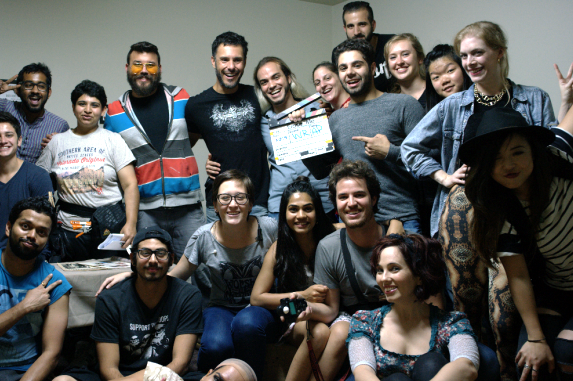
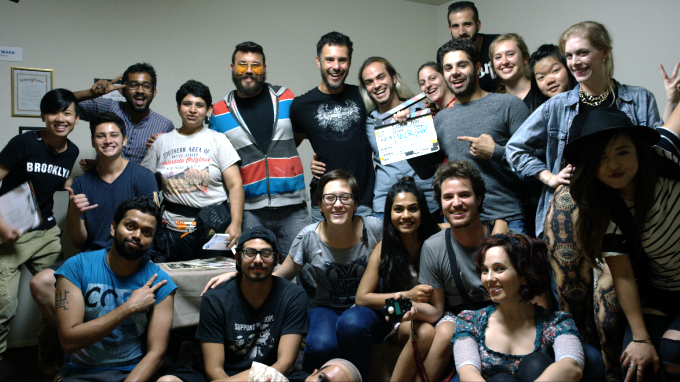
Short Film Production Crew and author/filmmaker Lucas Paz
A filmmaker’s decision — whether more or less experienced — to make a short film can involve a variety of purposes and goals. Some of these motivations are explored in this article, along with what may result from their achievement.
In the beginning, everything was short: learning how to tell a story through image and sound
The first stories told through film were initially short. This was an empirical discovery of how a succession of photographs or frames of an action could register motion and, depending on how the plot — the sequence of actions or events — was organized, build e-motion.
From recording and screening everyday facts to elaborating an audiovisual narrative with beginning, middle, and end, there is a long historical path that moves through manually rotated drawings, photography, film rolls, and digital files.
From black and white to hand-painted film rolls, to Technicolor, and then digital coloring. From silent films with live orchestras to mono, stereo, and eventually the Digital Dolby Surround System. From private screenings in houses and galleries to public fairs, movie theaters, and today’s streaming and VOD platforms.
This work in progress known as the 7th Art has been in constant development for over 200 years.
The way — and the time — we dedicate to watching and relating to films has changed not only due to advances in filmmaking tools and exhibition devices, but also because of economic, cultural, and political circumstances of each era. Films were initially created as records and studies of reality and movement by scientists and artists, later becoming a medium for imagination, entertainment, escapism, and the revelation of distant realities.
What is what? Formats and definitions
French pioneer Étienne-Jules Marey, a key figure in photography and cinematography, developed the chronophotographic gun, capable of capturing 12 consecutive frames. Louis Aimé Augustin Le Prince, considered by many historians the true father of motion pictures, filmed the first moving images on paper film using a single-lens camera.

Author/Filmmaker Lucas Paz with Brazilian Actress Sonia Braga
The Lumière Brothers, often regarded as cinema pioneers, improved Edison’s Kinetoscope by developing a lighter and more practical device — the Cinématographe — operating at 16 frames per second.
This long history of cinema explored creative ideas almost exclusively through short films, featuring artists such as Edwin Porter, Charles Chaplin, Luis Buñuel, Georges Méliès, and Maya Deren, who shaped our contemporary understanding of audiovisual language long before feature films became dominant.
Some historic short films include:
-
Life of an American Fireman
-
Arrivée d’un train en gare de La Ciotat
-
Un Chien Andalou
-
Le Voyage dans la Lune
-
At Land
Definitions and industry terms
According to the Academy of Motion Picture Arts and Sciences, a short film is “an original motion picture that has a running time of 40 minutes or less, including all credits.”
Other commonly used terms include:
-
Featurette: longer than a short subject but shorter than a feature film
-
Short subject: an industry term now rarely used
-
Short Shorts: films ranging from seconds up to about 5 minutes, depending on festival criteria, with specialized markets and distribution
Expanding the scope of the entertainment industry, music videos, teasers, trailers, commercials, and PSAs can also be understood as well-crafted short narratives, often emotionally driven and designed to sell a product or raise sociopolitical awareness. Many directors coming from advertising became successful film and TV directors due to their mastery of concision, pacing, and mass culture.
Find your voice

They offer creative freedom with lower financial risk.
There are many reasons filmmakers choose to develop short films. From beginners to well-established professionals, short films provide a creative environment that allows for experimentation and risk-taking.
Calling card
Many filmmakers use shorts to build a reel, showcase style and skills, and present their work online, at film markets, festivals, and to sponsors, producers, and investors.
Pitch
Short films are often used to pitch ideas for feature films or TV series. This includes pilots, elevator pitches, or viral shorts that lead to development deals with major studios.
This approach can result in:
-
A trailer or key scene from a feature proposal
-
A pilot introducing characters and narrative arcs
-
Characters presented in alternative contexts to demonstrate their strength and appeal
Notable examples include Whiplash, by Damien Chazelle, whose feature film development began with a short scene, and Cine Holliúdy, by Halder Gomes, originally pitched as a short titled The Artist Against the Evil Guy.
Laboratory
Established artists often find short films to be a space for exploring new styles and challenging creative habits. Actors such as James Franco, Edmilson Filho, Jodie Foster, and Kevin Spacey have used shorts to explore directing, writing, producing, or performing roles beyond blockbuster conventions.
Directors like Michel Gondry, Hugo Prata, David Lynch, and Guillermo del Toro continue to develop short-form content (from 30 seconds to 40 minutes) across advertising, music videos, and TV series.
For film students, high school creators with mobile cameras, or experienced artists, short films offer a low-cost, high-risk creative environment to master tools, discover style, and communicate a personal vision of the world.
Enough of a story in itself
Short films can stand alone as complete works of art.
One of the most important realizations about storytelling is that some stories are better told short. As in literature, a short story can be as powerful as a novel — capable of evoking emotion, prompting reflection, and influencing decisions through concise and precise narrative construction.
European audiences, for example, widely recognize short films as a standalone artistic language, understanding that while shorter duration limits detail, it enables stories that could not otherwise be told.
This approach goes beyond viewing short films merely as calling cards or pitches, embracing them as complete works of art.
Final note
Be sure to check Part 2 of this article, where we will explore topics such as film financing, distribution, new platforms, and perspectives from Brazilian and American professionals in the industry.
About the Author
Lucas Paz is a Brazilian multimedia artist working in Film, Theater, and Visual Arts. He holds a BA in Theater Directing from the University of São Paulo and an MFA in Film from the New York Film Academy. Lucas has worked with actors and directors from both Hollywood and Brazil and is CEO of (PRE)FORMA-SE Artistic Productions. www.lucas-paz.com
FAQ – Frequently Asked Questions
1. What defines a short film?
A film with a runtime of 40 minutes or less, including credits.
2. Are short films only for beginners?
No. Many established filmmakers use shorts as artistic laboratories.
3. Can a short film become a feature film?
Yes. Several successful features began as short films or proof of concept.
4. Do short films have a market in the US?
Yes, especially through festivals, streaming platforms, and digital distribution.
5. Why are short films artistically important?
They allow concise storytelling, creative risk, and unique narrative experimentation.