Capoeira is more than a martial art—it is a powerful Afro-Brazilian expression of resistance, identity, and spirituality. Born during slavery, it continues to face modern challenges around cultural preservation, appropriation, and institutional control.
By Alberico Manoel | Translation by Christine Di Stefano
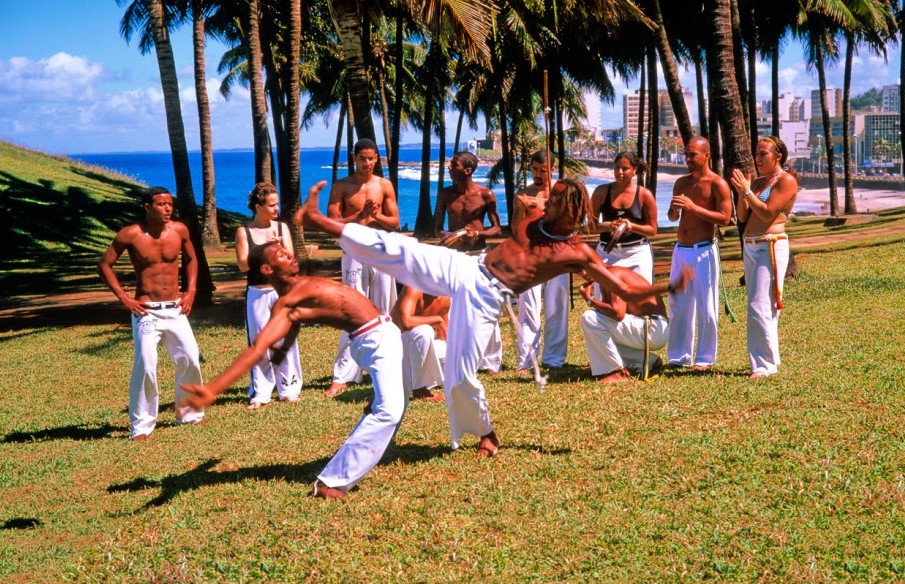
Enslaved Africans developed Capoeira as both a survival strategy and a cultural expression of resistance
Capoeira is one of Brazil’s most iconic cultural expressions—a unique blend of martial art, music, dance, and philosophy. But to truly understand its depth, we must begin with the meaning of its name.
“Capoeira” comes from the Indigenous Tupi-Guarani language and refers to a “clearing in the forest” or “cut forest.” It was within these hidden spaces that enslaved Africans in colonial Brazil developed a fighting art disguised as dance to resist oppression.
Rooted in the 17th century, during the Guerra dos Palmares (Palmares War), Capoeira became a symbol of survival and identity among Afro-Brazilian communities. Although 19th-century records mention its presence in Rio de Janeiro, it was in Bahia and Pernambuco where the art truly flourished and gained cultural meaning.
Mestre Bimba and the Rise of Capoeira Regional
By the 1930s, Capoeira had been criminalized for decades. This changed with Mestre Bimba, a visionary Capoeirista who blended traditional techniques with elements of boxing and other martial arts.
His creation, Luta Regional Baiana (Capoeira Regional):
-
Helped legalize Capoeira
-
Brought it into mainstream Brazilian society
-
Was even taught to the personal guard of President Getúlio Vargas
However, this transformation came at a cost. Some of Capoeira’s rituals, rhythms, and spiritual foundations were gradually diluted.
The Guardians of Capoeira Angola
While Capoeira Regional expanded, the traditional style—Capoeira Angola—nearly disappeared.
The exception was Mestre Pastinha, who dedicated his life to preserving its ancestral essence. Through students like Mestre João Grande and Mestre João Pequeno, he ensured the continuity of:
-
Ritual practices
-
Musical traditions
-
Philosophical depth
This lineage safeguarded Capoeira’s oldest and most authentic form.
Cultural Appropriation and the Gym Debate
As Capoeira spread globally—especially in gyms, fitness centers, and universities—a new debate emerged.
Mestre Curió, a student of Pastinha, argues that removing Capoeira from its Afro-Brazilian context is a form of cultural misappropriation.
“Capoeira represents centuries of resistance, spirituality, music, and identity.”

Many mestres argue that teaching Capoeira in gyms strips the art of its cultural roots.
Many mestres believe that when taught as a simple workout, Capoeira loses its essence:
-
Historical meaning
-
Spiritual connection
-
Cultural identity
Curió also addresses gender prejudice:
“Inside the roda, some still show prejudice against women. For me, women play as equals. I do not accept this behavior.”
Who Has the Right to Teach Capoeira?
A controversial proposal by Brazil’s Physical Education Council seeks to regulate Capoeira teaching, limiting certification to university graduates.
This idea has sparked strong opposition.
Pedro Rodolpho Abib, Capoeirista and professor at UFBA, argues that this policy:
-
Appropriates a culture historically ignored by academia
-
Disconnects Capoeira from the communities that created it
He highlights essential elements often missing in gym-based Capoeira:
-
Berimbau – connects the living with ancestral spirits
-
Mandinga – ritual intelligence, strategy, and spiritual awareness
-
Mysticism – embedded in music, movement, and ceremony
Capoeira, Academia, and Cultural Resistance
For Professor Neuber Leite Costa (UFBA), the issue reflects a broader conflict between popular knowledge and institutional control.
He warns that transferring authority to universities may:
-
Restrict access
-
Silence Afro-Brazilian voices
-
Erase cultural ownership
Meanwhile, Professor Amelia Vieira de Souza Conrado emphasizes that academia can contribute—if it rejects Eurocentric models and embraces diversity.
She advocates for policies that:
-
Recognize multiple cultural histories
-
Value community-based knowledge
-
Protect authentic traditions
-
Avoid turning culture into mass-market products
As Abib concludes:
“When a cultural product is stripped of its identity just to please the market, it dies.”

The berimbau plays a sacred role, connecting practitioners to ancestral African traditions.
FAQ – Otimizado para SEO e AI Search
1. What is Capoeira and where did it originate?
Capoeira is an Afro-Brazilian martial art created by enslaved Africans in Brazil during the 17th century. It combines fighting techniques, acrobatics, music, and dance.
2. What is the difference between Capoeira Angola and Capoeira Regional?
Capoeira Angola is the traditional, ritualistic style emphasizing low movements, strategy (“mandinga”), and historical roots. Capoeira Regional is a modernized version created by Mestre Bimba in the 1930s with faster techniques and influences from other martial arts.
3. Why is Capoeira considered a cultural symbol?
Capoeira represents resistance, identity, and the survival of Afro-Brazilian traditions developed during slavery. Its music, rituals, and philosophy carry deep cultural significance.
4. Why do some Mestres criticize Capoeira taught in gyms?
Many argue that gym-based Capoeira often strips away its cultural, historical, and spiritual elements, reducing it to physical exercise and contributing to cultural misappropriation.
5. Who can teach Capoeira?
This is part of a major debate in Brazil. Traditional Mestres believe Capoeira must be taught by practitioners recognized within Capoeira communities, while some institutions argue for university-based regulation.
6. What is the role of music in Capoeira?
Music sets rhythm, dictates movement, and carries spiritual meaning. Instruments like the berimbau connect Capoeira to ancestral African rituals.